


I'm Nerijus. I own hard technical problems end-to-end and I care about what they do for the business.
- Problem-first, tool-secondI figure out what actually needs building, then I build it. No wasted cycles on the wrong thing.
- AI where it earns its placeThree years of building AI systems into real products: agents, workflows, and retrieval. I use it where it solves the problem, not as decoration.
- Connects the dotsI've shipped SEO systems, marketing platforms, and growth tools. I see how the pieces fit.
- Outcomes over outputI think about what moves the business, not how many tickets I close.
Case study · 2026 Q2
Recovering a publisher whose Google Discover traffic dropped to zero
A digital publisher lost almost all of its Google Discover traffic after a Google core update, and Discover was where most of its readers came from. The impressions went to zero and stayed there for months. I rebuilt the quality signals the site was missing, held the site steady through the wait, and when Google next re-evaluated, Discover switched back on across their titles and the main site reached its best month on record.
In brief: A publisher's Google Discover traffic dropped to zero after a Google core update. My audit found articles without Discover-ready images, broken images and structured data, a schema bug crediting articles to a different site, missing authors and descriptions, and thin pages. I fixed those, then held the site steady. During Google's next core update, Discover came back across every title on the same day, and the main site went on to its best Discover month on record.
Before: Dropped from Google Discover after a core update, with its main traffic channel sitting at zero.
The stakes
Most of this publisher's readers came from Google Discover, the feed of articles Google shows people on their phones. Then a Google core update rolled through and their titles fell out of Discover completely. The impressions went to zero and stayed there. For a publisher that runs on Discover, that is the main source of readers vanishing overnight, with no query to rank for and no button to press to bring it back.
Why the Discover traffic dropped, and why it stayed down
Discover doesn't come back because you fixed it. It comes back when Google re-evaluates you, and only if you pass.
Search answers a query, so if you rank, you show up. Discover is a recommendation feed that decides on its own whether to put you in front of someone. Once a site falls below the quality bar it stops getting picked, and normal recrawling doesn't undo that. The thing that re-opens the door is one of Google's broad core updates, when it re-scores sites from scratch. So the job was to make the site clearly good enough to be recommended again, and to have all of it in place before the next core update looked. Google says Discover can fluctuate for reasons unrelated to a site's quality. In this case, the simultaneous collapse, the technical findings, and the same-day return across titles pointed to a site-wide reassessment, so that's what I treated it as.
What I did
I rebuilt the signals Discover actually cares about. The articles had no proper images, so I gave them images at the size Discover needs, covering almost the whole catalogue. I cleaned up the things that quietly tell Google a site is low quality: broken images, broken structured data, a schema bug that was telling Google the articles belonged to a different site, missing author information, missing descriptions. I trimmed the thinnest pages that were dragging the whole site's quality down, with a safety check so nothing that was still earning traffic got touched. Every change was reversible and tested on a small batch before it went out.
The harder part was stopping. In my experience every big change restarts Google's re-evaluation clock, so once the fixes were in I held the site steady and waited, watching the numbers with a tracker I built to pull the data every day.
The result
When Google's next core update rolled out, Discover switched back on across their titles on the same day. The main site held, and went on to its best Discover month on record, above its previous seasonal peak. Some of the smaller titles came back and then faded. A channel that had been at zero for months was live again.
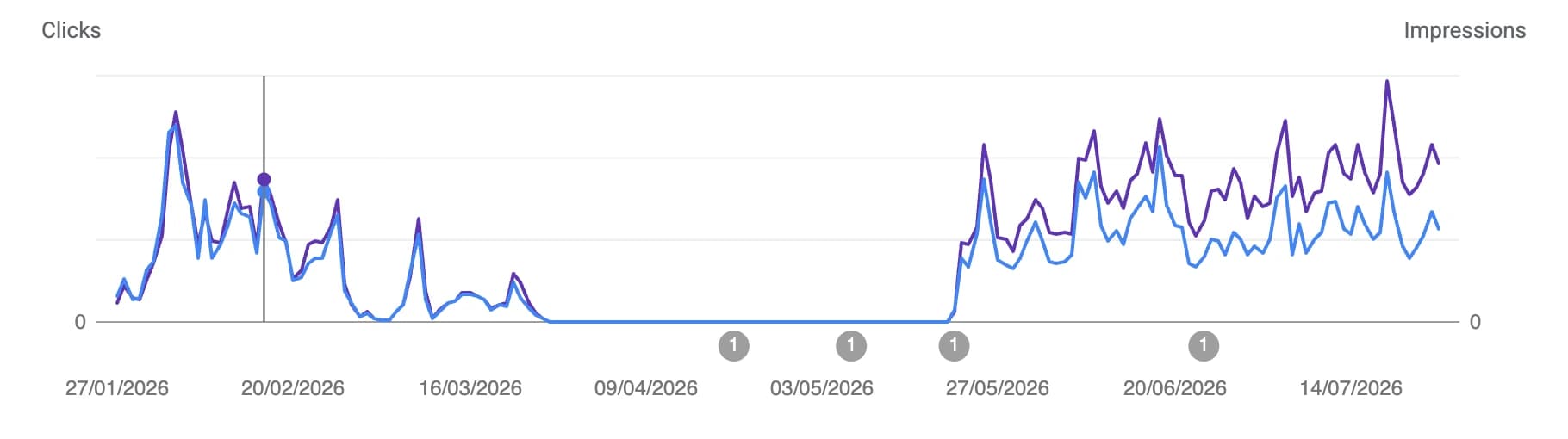
Getting back into Google Discover means making the site good enough to be recommended again, then waiting for Google to re-score it. The timing is Google's to decide, so the work is being ready before it does.
Discover traffic down after an update? Let's talk it through.
Book a callMore case studies
- Stabilizing a WordPress news network that kept crashing under match-day traffic
Down on every Denmark match, and the owner had no direct access to his own servers.
- Restoring a publisher's lost archive after a CMS migration
Most of the archive missing after a CMS migration, with Google still requesting the vanished URLs.
- Building an AI content pipeline that cut a marketing agency's cost per blog post
Every client blog post started from scratch with a contract writer, at roughly $250 each.
Trusted by Founders and CEOs

What stands out about Nerijus is that he's not only excellent technically; he's a T-shaped developer with a breadth of marketing knowledge who can converse with marketing leadership about decisions that will impact revenue.
Zach GroveVP of Marketing, NextivaMinneapolis, USAThere are many developers out there, but very few that are as trustworthy and on top of things as Nerijus. Our agency continues to turn to him for help, and he always delivers. On top of his sharp skill set, he is an absolute pleasure to work with.
Kim CruickshanksCEO, Fuze BrandingLos Angeles, USAWorking with Nerijus as an agency has made our process and workflow unbelievable. He is incredibly talented developer but what really makes him stand out is his work ethic and steady approach. I highly recommend Nerijus.
Daniel MezaCEO, Muze DevelopmentHouston, USA




Let's talk
Happy to talk through whatever you're working on, whether you're building something or stuck on something. Book a time below.
Book a Time